Diamond Bar Wood Flooring has handled wood flooring in Commerce for homeowners and property owners over our 20-plus years in the trade, and nearly all of that work has been on floors that already exist. We refinish worn oak, replace damaged boards, rebuild stair treads and lay new hardwood over old subfloors. Before a sander touches a room, we confirm the year the house was built, because that date shapes how we handle dust, trim and the boards underneath.
A floor job in a lived-in home is a different project from one in a new build, and we plan it that way. We seal off the work area with a dust containment system, move through the house room by room, and keep a path open so a family can stay while the floors are done. Nobody has to find somewhere else to sleep for a week.
Our finishes fit the South Coast AQMD Rule 1113 limit for wood coatings, a rule that binds anyone applying or storing those coatings on a job site. We follow lead-safe work practices in homes built before 1978, which covers most of the houses we see in this city. When an engineered floor is involved, we measure its wear layer before promising that it can be sanded at all.
Floors in Commerce’s 1940s and 1950s Homes
Commerce’s housing is a closed stock. The American Community Survey 2024 five-year estimates count 3,381 housing units in the city, and 52.2 percent of them were built between 1940 and 1959. The same estimates show no units built in 2010 or later, so every floor we work on here sits in a house that has already lived through decades of use.
An Existing Floor Is the Starting Point
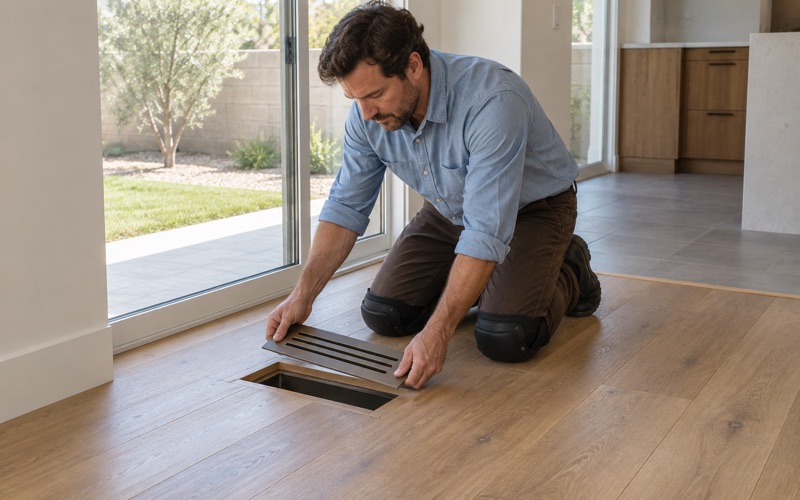
With 887 units dating to the 1940s and 877 to the 1950s, the typical Commerce job begins with a floor someone else put down long ago. That floor may be original solid hardwood, a later layer of carpet or sheet vinyl, or a patchwork of repairs from several owners. Our first visit is about finding out which, lifting a vent cover or a corner of carpet where we can.
Only 3.6 percent of the city’s housing dates to 2000 or later. The questions we answer in Commerce are rarely about choosing a floor for bare framing. They are about what the existing subfloor, joists and boards will allow, and what a new finish or a new floor has to work around.
What Older Oak Floors Usually Need
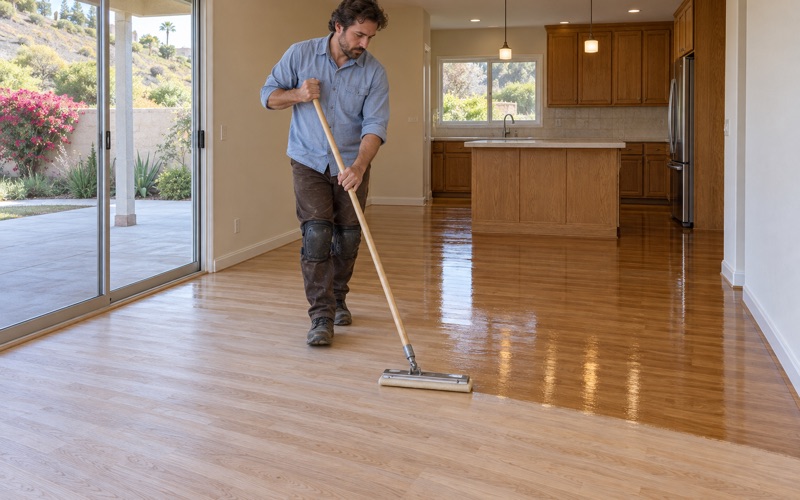
Hardwood from this period is often red oak or white oak strip, nailed down and site-finished. Every past sanding removes wood above the tongue, so we check board thickness at a register or threshold before we recommend a full sand. If enough wood remains, we work through a grit sequence with a drum sander, an edger and a multi-head orbital sander, then apply sanding sealer and the chosen topcoat.
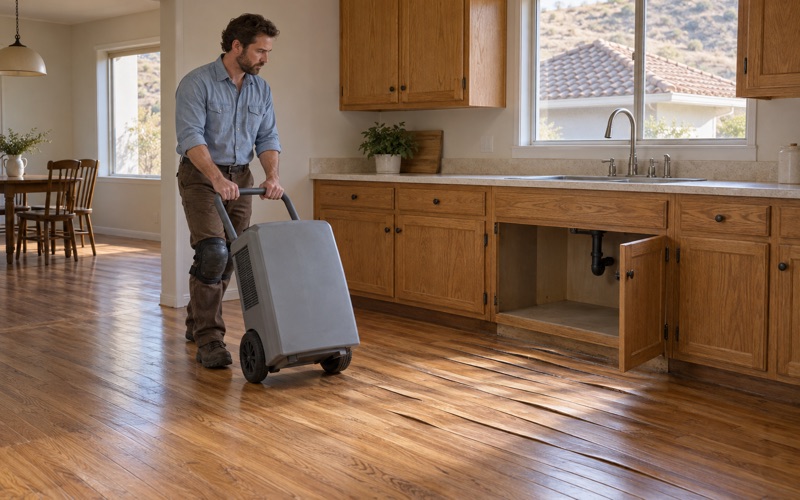
Where boards show cupping, crowning or wide board gapping, we look for the cause before sanding anything flat. A floor that cupped from moisture below will move again if the source is still there, so pin moisture meter readings come first. Loose or squeaking areas may call for new flooring cleats or flooring staples into the subfloor rather than more sanding.
Subfloors, Joists and Old Coverings
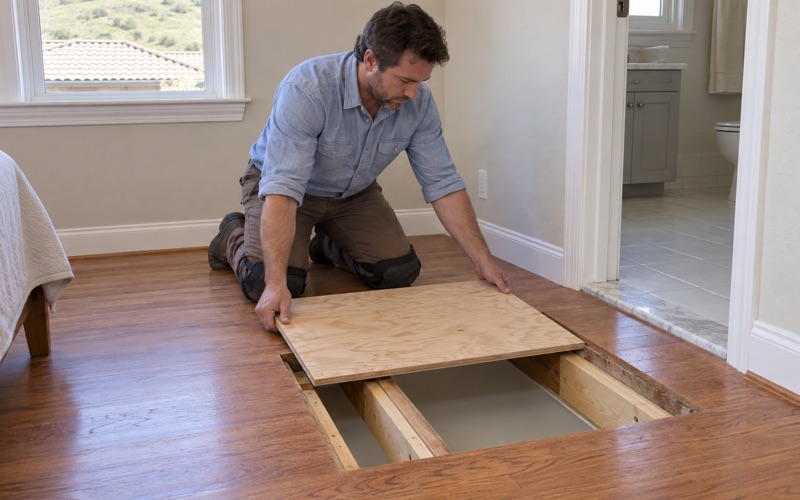
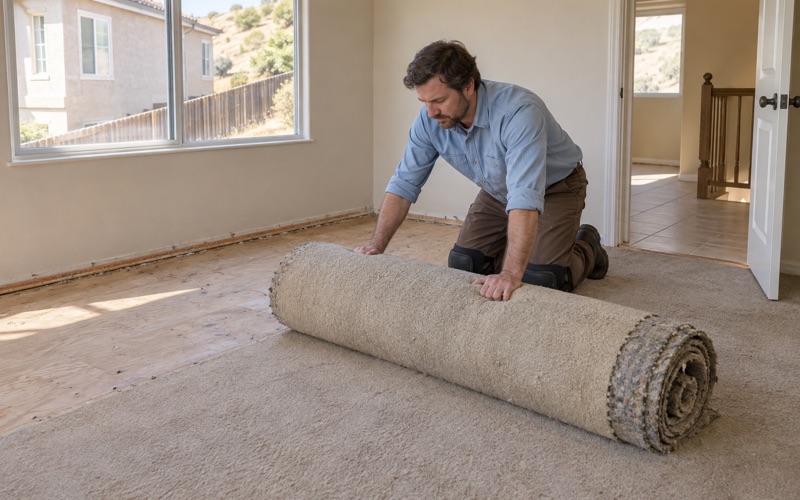
Pulling up carpet or vinyl in a house from the 1940s or 1950s can reveal hardwood worth saving, a plank subfloor or old adhesive. Black mastic and cutback adhesive turn up under older resilient flooring, and we assess them before anything is scraped or ground. If a floor feels soft or bounces, we look at the floor joists from below where access allows, and a sistered joist may be needed before new boards go down.
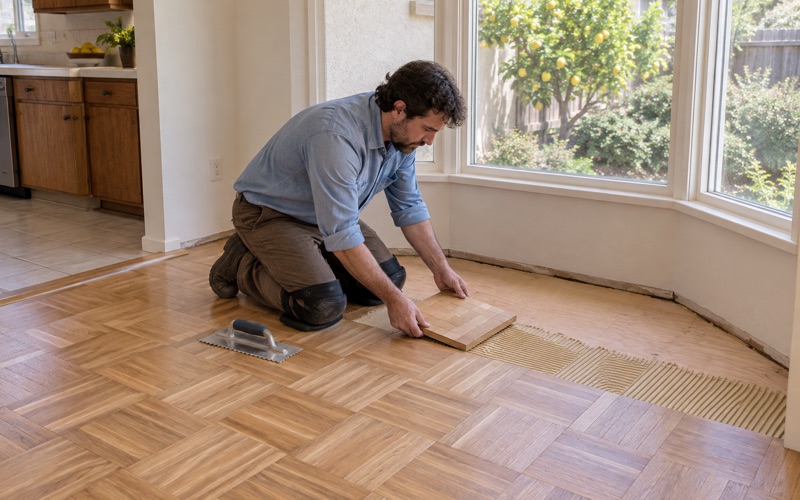
We do not assume what a Commerce house sits on. Foundation type varies from one house to the next, so we check each home before recommending nail-down, glue-down or floating installation. Where a concrete slab is present, we use an in-situ relative humidity test under ASTM F2170 before any wood goes over it.
Looking for wood-flooring closer to Los Alamitos? See Wood-Flooring in Los Alamitos.
Homes in Bandini, Rosewood and Laguna
Commerce incorporated in 1960 to keep Vernon and Los Angeles from annexing its industrial land. Residents of the Bandini, Rosewood and Laguna residential communities had joined industrial leaders in that effort in the late 1940s, so those neighborhoods were home to families before the city itself existed. The Atchison, Topeka and Santa Fe main line had come through the area long before that, in 1887.
Matching Boards in an Older House
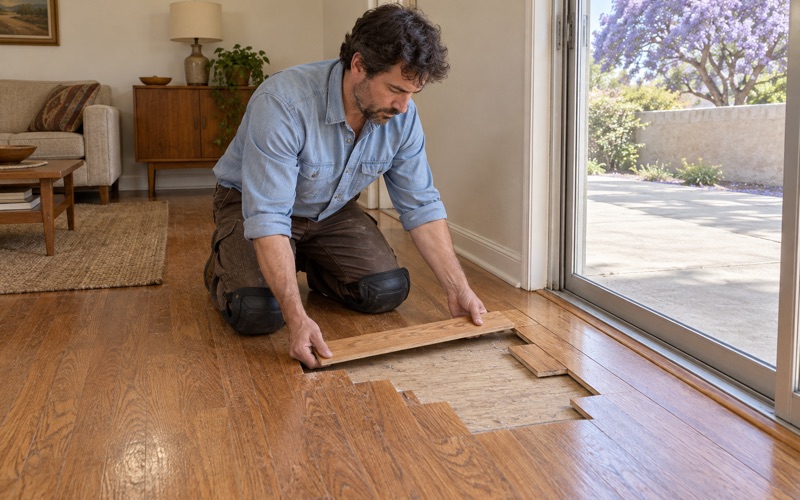
A room addition, a removed wall or a damaged section often leaves a floor that no longer lines up. In a home of this age, we match species, board width and grade as closely as the existing floor allows, then weave new boards in rather than laying a straight seam across the room. A weave-in repair is sanded and finished with the rest of the floor so the patch reads as part of the original.
Older floors often carry mineral streaks, nail holes and color variation that read as character grade, while new select grade stock looks cleaner. We tell homeowners up front when a close match is unlikely. Sample boards are finished and laid beside the old floor before the job is scheduled, so nobody is surprised afterward.
Termites, Leaks and Water Damage
Drywood termites can hollow out boards in a floor that has been in place for decades. When we find termite frass, kick-out holes or tunneled wood, we stop and refer the homeowner to a licensed pest company before replacing any boards, since new wood laid next to an active colony will not last. If tent fumigation is scheduled, board replacement waits until it is finished.
Water damage calls for the same order of work. We find the source of the leak and take moisture readings before replacing boards, and we photograph and document the damage so an insurance adjuster sees what we see. Replacing boards before the leak is fixed only sets up the same repair again.
Stairs and Doorway Transitions
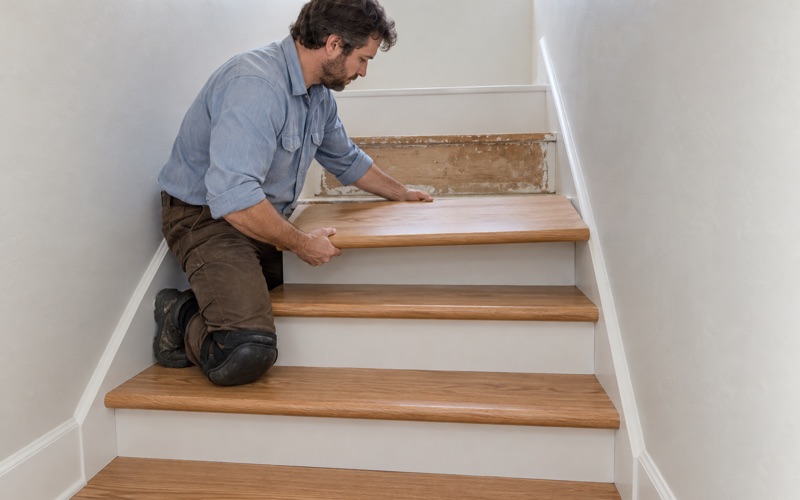
Where a home has a staircase, we quote it by the tread and riser instead of folding it into a square-foot price. Each bullnose tread, stair riser and stair nosing is fitted and finished by hand, and the price should show that work plainly.
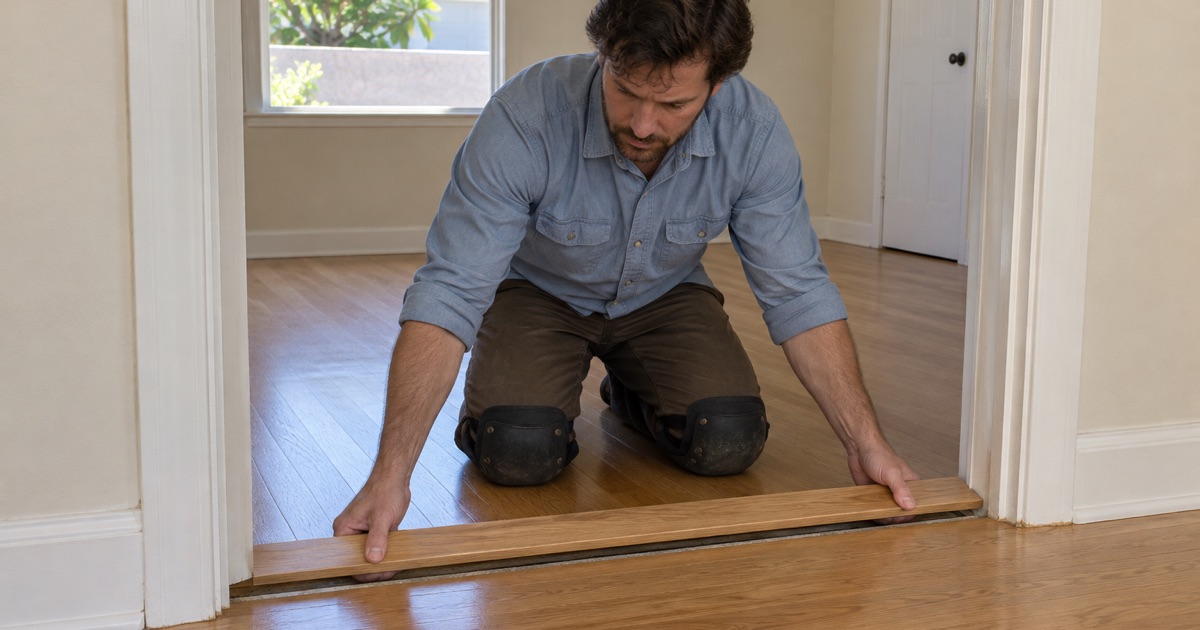
Doorways need attention too, especially where new hardwood meets tile or an older floor at a different height. A T-molding or a reducer handles that change cleanly and keeps the edge from catching a toe or a chair leg.
Rented Houses and Attached Homes
Many Commerce homes are rented rather than owner-occupied, and some share a wall with the next unit. The ACS counts 572 renter households living in detached houses, which is 38.4 percent of the city’s renter households, and 411 housing units, or 12.2 percent, are one-unit attached homes. Both groups bring their own planning questions to a floor job.
Floors in a Rented House
When a detached house is a rental, the owner and the tenant often have different timelines. We schedule a full refinish between tenancies where possible, because a sand and finish goes best in an empty house. When a tenant is still living there, dust containment and a room-by-room sequence keep the work to one part of the house at a time.
Owners preparing a rental for turnover sometimes ask about a screen and recoat instead of a full sand. On a floor whose finish is intact and only worn at the surface, a screen and recoat restores the sheen level in far less time. We photograph the floor before work starts, which gives the owner a clear record of its condition at the end of a tenancy.
Attached Homes and Shared Walls
A one-unit attached home shares a wall with a neighbor, and floor work there has more to consider. Where an attached home belongs to an association, we check its rules and any architectural review committee requirements before a floor is ordered. That step matters because an association can govern flooring type and underlayment.
When an association raises impact noise, sound-rated underlayment usually enters the conversation for floating and glue-down floors. We work from what the association’s documents actually require and from the product data for the underlayment, not from a general rule of thumb.
Choosing a Floor That Holds Up
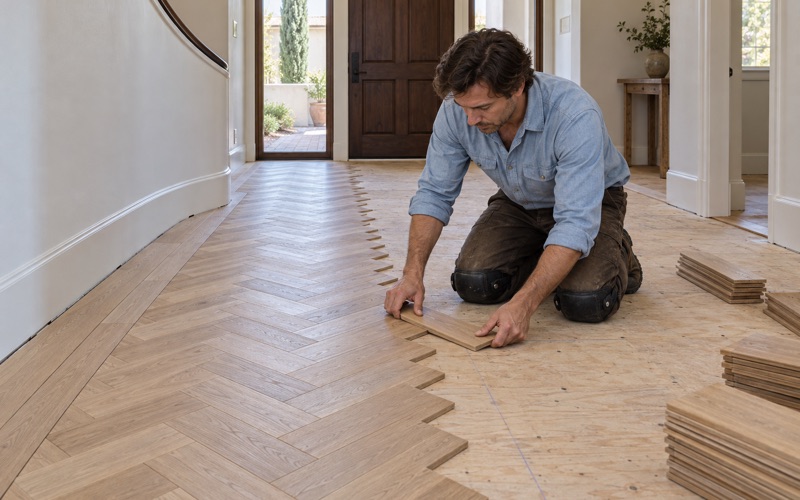
For rentals and attached homes alike, durability usually leads the discussion. White oak and hickory rate higher on the Janka hardness rating than softer species, and an engineered hardwood with an aluminum oxide prefinish goes into service faster than a site-finished floor. Wide plank looks and patterns such as herringbone are possible too, though they take more time to lay.
Getting a Floor Job Started in Commerce
A Commerce floor project begins with a visit to the house. We look at the floor, confirm the year the home was built and check what sits under the current surface where we can. From there we write up the scope, with stairs, board replacement, subfloor work and finish each listed on their own lines.
The City’s Building and Safety Division
The City of Commerce Building and Safety Division, part of Economic Development and Planning, handles plan check, building inspections and building permits. According to the city, plans submitted for plan check from January 1, 2026 are checked against the 2025 California codes, including the Building, Residential and Green codes. When our floor work is part of a larger remodel, we ask the homeowner what the division has told them and set our schedule around it.
Picking a Finish
Waterborne polyurethane, oil-modified polyurethane and hardwax oil each look and wear differently. Waterborne finishes stay clearer on white oak, oil-modified finishes add an amber tone that many owners like on older red oak, and hardwax oil is easier to spot-repair but asks for more upkeep. We apply a sample on the actual floor so the color is settled before we commit to a whole room.
What Happens After the Last Coat
Every refinish comes with a written cure schedule. It tells the household when to walk on the floor in socks, when furniture can go back and when rugs can be laid, since rugs trap a finish that is still hardening.
We walk through that schedule in person before we leave. Felt pads for furniture legs and a plan for the first cleaning round out the handoff, so the floor gets a good start in a house that has already seen some 70 years of life.
- 20+ Years of Wood Floor Work
- Free In-Home Estimates
- Dust-Contained Sanding