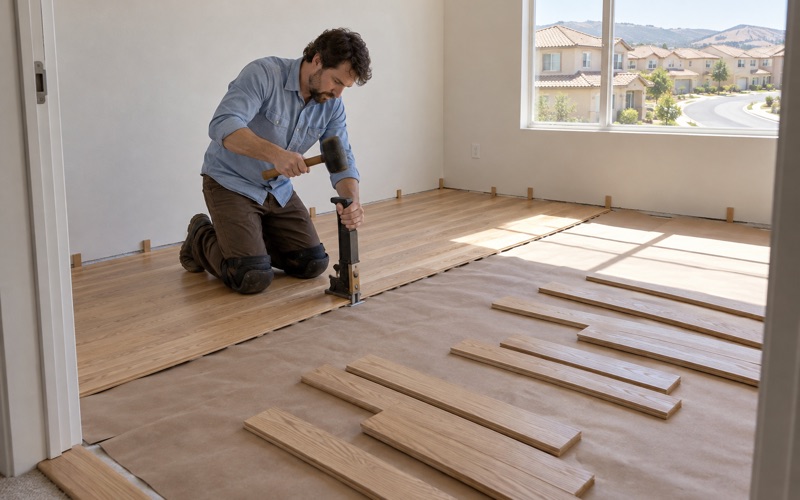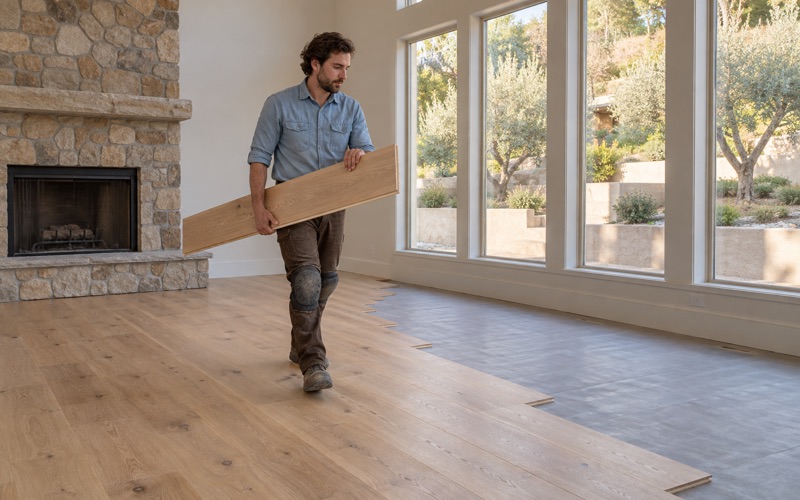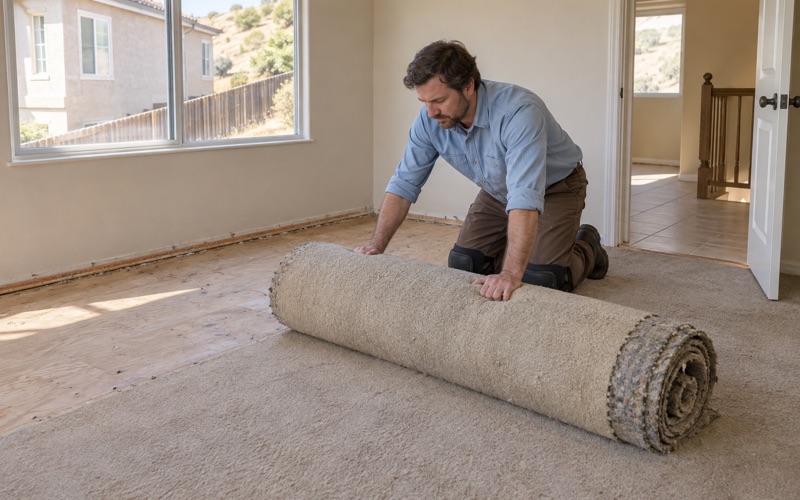
Diamond Bar Wood Flooring has spent more than 20 years on wood-flooring in Covina and across the valley, and most of what we do here starts with a question about age. Before a sander touches a board, we pin down the year the house was built, because that one date shapes the finish plan, the dust plan and the lead-safe steps that come with it. Refinishing, repair, new installation and stair work all follow from that first check.
A large share of the floors we see were laid in the postwar decades, often hidden under carpet that went down a generation later. Some are solid oak in good shape, some have been sanded so many times the tongue is close to showing, and some are engineered products that can take one more pass or none at all. We measure rather than guess, so the quote you get matches the floor you actually have.
Rentals and attached homes make up a big part of the local picture too, and they bring rules a detached house does not. We check association and building requirements before anything is ordered, and we plan the work room by room so an occupied home stays livable. Each refinish ends with a written cure schedule telling you when to walk, when to return furniture and when rugs can go back down.
Floors in Covina’s 1950s and 1960s Houses
An Era That Defines the Housing Stock
Census figures make Covina’s housing story unusually clear. The ACS 2024 five-year estimates count 33.2 percent of the city’s housing units as built in the 1950s and 23.9 percent in the 1960s, so 57.1 percent of everything standing went up between 1950 and 1969. Only 3.0 percent predates 1940, which means the typical job here is a ranch-era house rather than a prewar restoration.
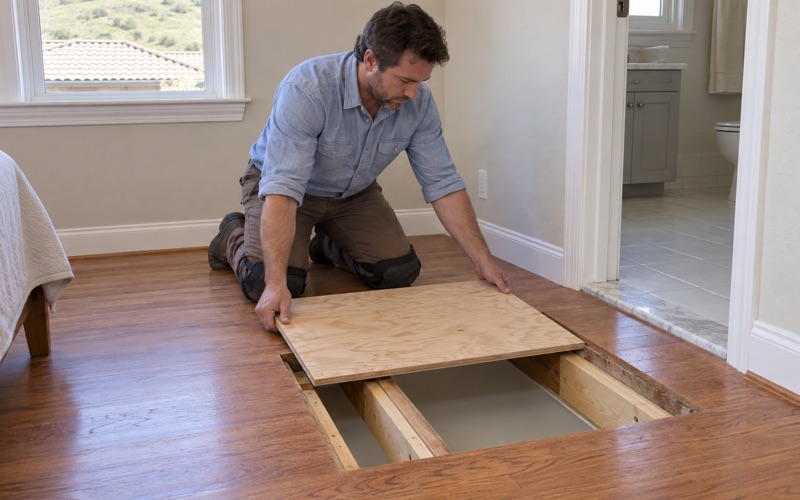
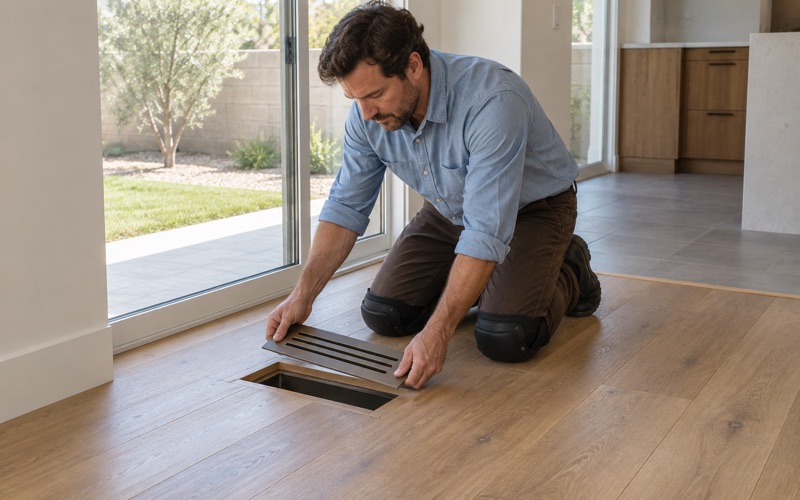
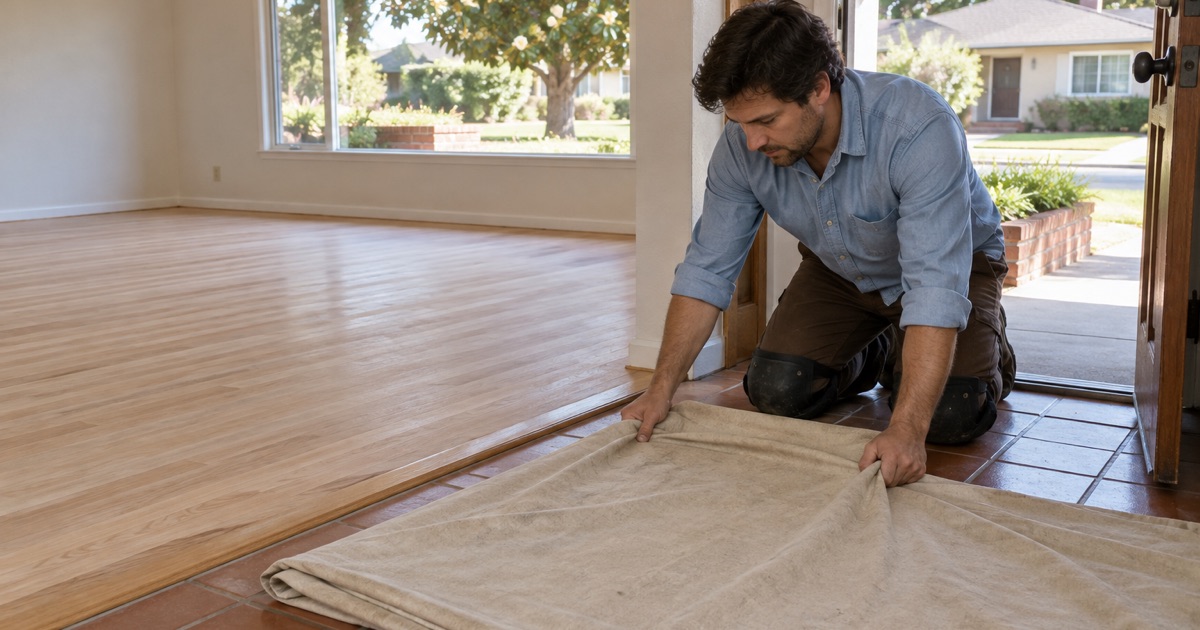
Houses from those two decades can carry strip oak nailed over a wood subfloor, though every home has its own history of remodels. We lift a vent cover or a corner of carpet to see the species, the board width and the fastener pattern before we talk price. Red oak and white oak take stain differently, and knowing which one you have avoids a color surprise at the end.
Sanding Floors in Pre-1978 Homes
Every house from this period was built before 1978, the line the EPA Lead Renovation, Repair and Painting Rule draws for target housing. Old paint on baseboards, door casings and shoe molding can be disturbed when an edger runs along the wall. We confirm the build year first and follow lead-safe work practices on those homes, with containment and cleanup matched to the work area.
Dust control matters for a second reason in homes where families stay put during the job. We run HEPA dust extraction on the drum sander and edger, seal off the rooms being worked, and move through the house in a sequence that keeps a kitchen and a bedroom usable. A grit sequence that climbs gradually also leaves fewer scratches for the finish to magnify later.
Worn Tongues, Engineered Boards and Replacements
Decades of refinishing take a toll on solid hardwood. When a board has been sanded close to the tongue, another full sand can expose nail heads or split the edges, and a screen and recoat may be the smarter choice. We show you what we found at the board edge so the decision is yours, not a guess buried in a quote.
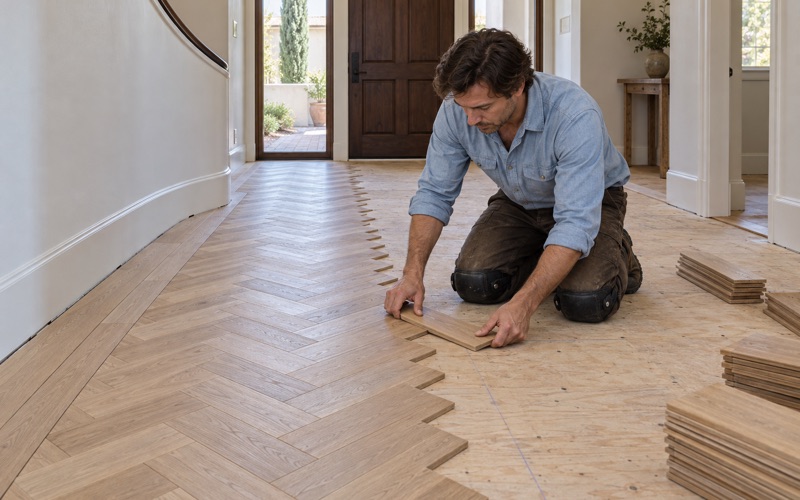
Many of these houses also received engineered hardwood or luxury vinyl plank during later remodels. Engineered products vary widely, so we measure the wear layer before saying whether a floor can be sanded at all. Where boards have to go, we weave in matching stock from a closet or pantry, or source new plain-sawn red oak or white oak in a comparable grade.
Looking for wood-flooring closer to Charter Oak? See Wood-Flooring in Charter Oak.
Older Cottages and Bungalows Near Citrus Avenue
What the Town Center Survey Recorded
Covina was incorporated on August 14, 1901, and spent the first half of the twentieth century as a citrus stronghold; by 1907 it claimed to be the third-largest shipping point of oranges in the world. The older houses from that era cluster around downtown. In 2007 the city received the Covina Town Center Historic Resource Survey, the first comprehensive study of the Town Center Specific Plan area.
The survey identified a potential Cottage Drive Historic District, a small pocket of early-twentieth-century cottages on Cottage Drive and Orange Street just west of Citrus Avenue, with 19 buildings and 13 potential contributors. Nearby it noted Craftsman bungalows, folk houses and a 1920s Spanish Colonial Revival courtyard housing development on the western border of Covina Park. Each of those is a finding about what could qualify, not a status the buildings hold today.
Potential, Not Designated
Covina has a historic preservation ordinance, but the 2007 survey stated that no properties were identified as local landmarks, and the LA Conservancy reports the city has not designated any. For a homeowner on one of these streets, the age of the house sets our precautions, not a landmark listing. That keeps the conversation on the floor itself: what it is, what shape it is in and how much of it can be saved.
Owners of these cottages often care about keeping original material anyway. We treat an old floor as something to save first and replace second, and we explain what a full sand will remove before starting. Photos of the boards before and after the work are easy to keep, and we take them as a matter of course.
Matching Early-Twentieth-Century Boards
Floors in cottages and bungalows of this age may be narrower, may be a species other than oak, and may have been patched after the porch enclosures and changed openings the survey noted on many older houses in the area. A weave-in repair staggers new boards into the old field so a patch does not read as a rectangle. We match board width and cut, whether plain-sawn, rift-sawn or quarter-sawn, before we blend the color.
Termite damage can turn up in older wood. If we see termite frass, kick-out holes or hollow-sounding boards, we stop and refer you to a licensed pest company before any replacement boards go in. Laying new wood over an active drywood termite problem only moves the damage into your new floor.
Covina Apartments, Townhomes and Attached Homes
Five-Plus-Unit Rental Buildings
Renters occupy 41.2 percent of Covina’s occupied housing units, and more than half of those renter households live in buildings with five or more units. That makes apartment turnover a steady part of flooring work in the city. Owners and managers usually need a floor that is durable, quick to restore and ready for the next tenant on a fixed date.
In a multi-unit building, a screen and recoat between tenants can extend the life of an existing site-finished floor without the cost of a full sand. Where boards are damaged, we replace them individually rather than tearing out a room. Dated photos of floor condition at move-out can also help a landlord account for deductions under Civil Code 1950.5, the security deposit statute.
Townhomes and Association Rules
Attached homes matter on the ownership side as well, with 13.0 percent of owner households living in one-unit attached structures. Attached homes are frequently part of a homeowners association, and California associations operate under the Davis-Stirling Common Interest Development Act. Associations can set rules on flooring type, underlayment and work hours, and some route requests through an architectural review committee.
We check association and building rules before a floor is ordered, not after it arrives. Where a sound-rated underlayment is called for, we get the written requirement and choose a product documented to meet it. A floating installation, glue-down installation or nail-down installation each behaves differently over a shared wall or slab, and the rules often decide which one is allowed.
Scheduling Work in Occupied Units
Tenants and owners in attached homes rarely have a spare room to move into. We sequence the job so one area is finished and curing while the next is prepped, and dust containment keeps fine particles out of shared hallways and neighboring units. Waterborne polyurethane is a common choice in these settings because it cures with less lingering odor than an oil-modified polyurethane.
Planning Floor Work in Covina
Leaks, Moisture and the Season
Covina sits in National Weather Service forecast zone CAZ548, Los Angeles County San Gabriel Valley, where dry stretches and wetter months move indoor humidity up and down through the year. Wood answers that swing with board gapping in dry spells and cupping or crowning when moisture climbs. We acclimate new flooring and take pin moisture meter readings of the boards and the subfloor before installation.
Water-damaged floors get a different first step. We find the source of the leak, whether a supply line, an appliance or a slab leak, and take moisture readings before replacing a single board. Water, smoke and ash damage is photographed and documented so your insurance adjuster sees the same conditions we do.
Finishes, Air Rules and Local Offices
Covina is inside the South Coast Air Quality Management District, and SCAQMD Rule 1113 sets VOC limits for wood coatings that bind anyone applying or storing them on a job site. We select sanding sealer, stain and finish to fit that limit. Hardwax oil, waterborne polyurethane and a range of sheen levels all remain options, so there is still real choice in how the floor looks.
Questions about whether a particular scope needs city review go to the City of Covina Building & Safety Division at 125 E. College Street, which provides plan review and inspection services. Owners planning seismic work should know that Covina ZIP codes 91722, 91723 and 91724 appear on the 2025 Earthquake Brace + Bolt list for Southern California. Sorting that out before new floors go in keeps the two projects from getting in each other’s way.
Stairs, Timeline and Cure
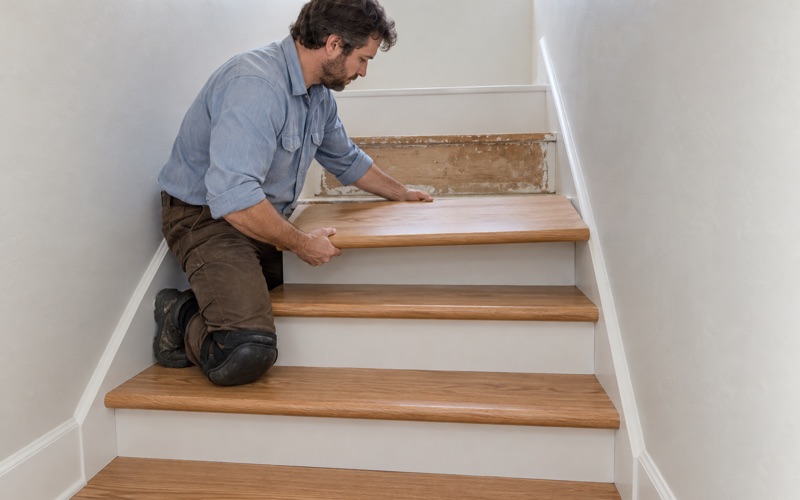
Stairs are quoted by the tread and the riser, never folded into a square-foot price, because each step carries its own sanding, stair nosing or bullnose tread detail and finish coats. Townhomes and two-story houses usually have a flight that deserves its own line in the quote. Pricing it that way also makes it easy to refinish the stairs on a different day from the rooms.
When the last coat goes down, you receive a written cure schedule for your floor. It tells you when socks are fine, when shoes are fine, when furniture can come back on felt pads and when area rugs can return. Following it protects the finish during the stretch when it is hardest to see and easiest to damage.
- 20+ Years of Wood Floor Work
- Free In-Home Estimates
- Dust-Contained Sanding