
Diamond Bar Wood Flooring handles engineered hardwood refinishing in Diamond Bar, CA, with more than 20 years spent sanding and finishing wood floors of every construction, and we serve surrounding cities including Walnut, Rowland Heights, South San Jose Hills, Pomona and Brea. Engineered floors can look exactly like solid hardwood, but refinishing them is a different job with much less room for error.
An engineered board is a real hardwood veneer, called the wear layer, bonded to a plywood or composite core. Only that veneer can be sanded. Once a sander passes through it, the board is ruined, and no amount of stain or finish will hide the core.
That is why our engineered hardwood refinishing always starts with a measurement, not a sales pitch. We look at the actual edge of a board in your home, then recommend a light sand, a recoat or replacement based on what is really there.
Measuring the Wear Layer First
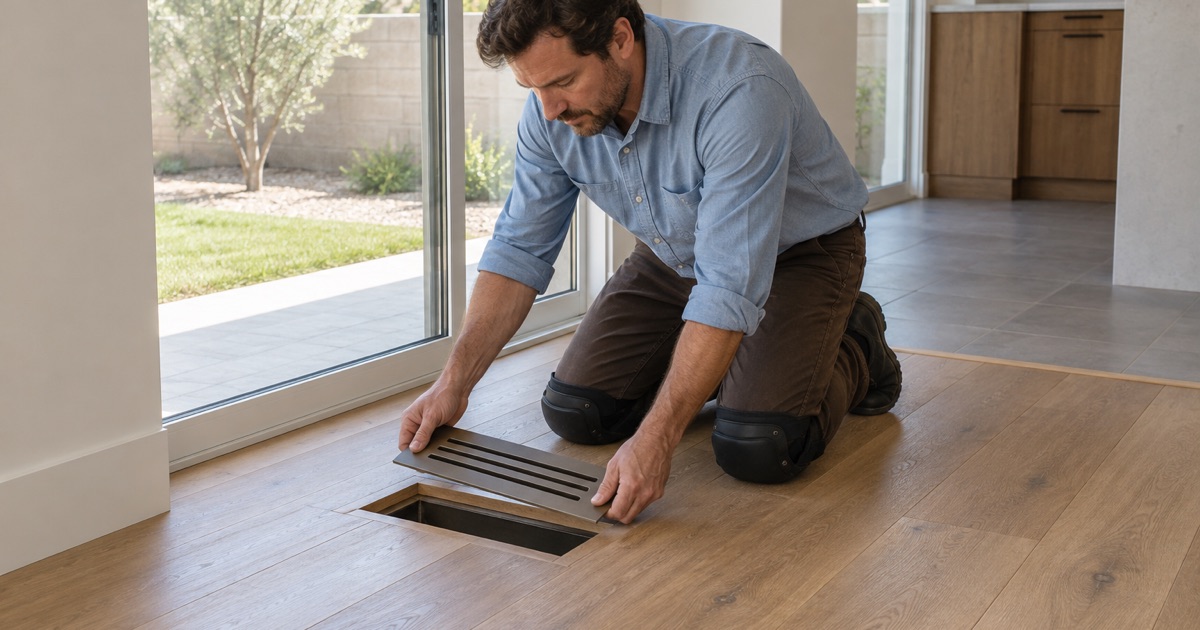
Finding a Board Edge to Measure
The wear layer is measured at an exposed board edge, which we find by lifting a floor register, removing a threshold, pulling a short piece of base molding or, on a floating floor, lifting a board in a closet. We look at the thickness of hardwood above the core with a caliper or rule. It takes a few minutes and answers the most important question before any money is spent. We measure in more than one place when the floor runs through several rooms, since past repairs may have introduced boards from a different product.
What the Measurement Tells Us
A generous wear layer can take a careful sanding with fine grits, sometimes more than once over the life of the floor. A thin veneer that has never been sanded may only tolerate a very light pass. A veneer that was already sanded once, or a thin one to start with, should be recoated rather than sanded. We explain the reading and what it allows, in plain terms.
Why Past Refinishing Matters
Many engineered floors in townhomes and condos have been through at least one previous owner, and it is not always clear whether they were sanded before. With 2,321 one-unit attached homes in Diamond Bar, that uncertainty comes up whenever a townhome changes hands. Measuring removes the guesswork that comes with a floor whose history is unknown.
Sanding Engineered Floors Safely
Fine Grits and Light Passes
When the wear layer allows sanding, we skip the coarse grits that remove wood quickly and work with finer abrasives and a multi-head orbital sander, which removes finish evenly without digging. The aim is to remove the old finish and surface wear while leaving as much veneer as possible for the future. Deep scratches that would require heavy sanding are often better handled by replacing individual boards.
Beveled Edges and Microbevels
Many engineered boards have a small bevel along each edge. A light sanding leaves those bevels in place, and old finish or dirt can remain in the grooves. We clean the bevels by hand, and where a flat, seamless look is wanted, we explain that removing the bevels entirely would consume more veneer than most engineered boards can spare.
Stain on Engineered Veneers
Staining is possible on a sanded veneer, but because sanding is kept shallow, the surface is less forgiving than solid wood. We test stain on a sanded sample area. A clear finish often gives the best result on thin veneers, preserving the natural color while avoiding the blotching that can come from limited sanding.
Recoating Over Factory Finishes
Screen and Recoat on Engineered Floors
A screen and recoat removes none of the wear layer, making it the preferred maintenance approach for most engineered floors. The existing finish is abraded, vacuumed and tacked, and a fresh topcoat is applied. It restores sheen, fills fine scratches in the finish and adds a new layer of protection. Done every few years in busy areas, recoating can keep an engineered floor from ever needing a full sanding.
Bonding to Aluminum Oxide Prefinish
Factory finishes containing aluminum oxide are extremely hard, and a new coat will peel if it is simply brushed on. We clean off residue from household cleaners, abrade the finish carefully, and use a bonding product where the finish system calls for it. A small adhesion test on the floor confirms the recoat will hold before we treat the whole room.
Finishes Within the Air District Limit
Recoats and new topcoats are selected to fit South Coast AQMD Rule 1113, which limits wood coatings to 275 grams per liter of VOC and applies to the contractor applying them. Waterborne systems suited to recoating engineered floors meet that limit and cure clear. You receive a written cure schedule telling you when to walk, return furniture and lay rugs.
When Replacement Makes More Sense
Delamination and Water Damage
Water that reaches the core can make the veneer lift, bubble or separate from the plywood layers. Delaminated boards cannot be refinished and are replaced. If the damage is limited, individual boards can be swapped for matching stock before the area is recoated.
Sand-Through and Worn-Through Boards
Boards where a previous sanding reached the core, or where traffic has worn the veneer away, show a different texture and color that no finish hides. We replace those boards individually where matching stock is available, or recommend replacing the room when too many are affected.
Choosing a New Engineered Floor
When replacement is the right call, we help you choose a product with a thicker wear layer for future refinishing. Composite cores in engineered flooring sold in California must meet CARB Phase 2 or TSCA Title VI formaldehyde standards, and we check product labeling before ordering.
- 20+ Years of Wood Floor Work
- Free In-Home Estimates
- Dust-Contained Sanding