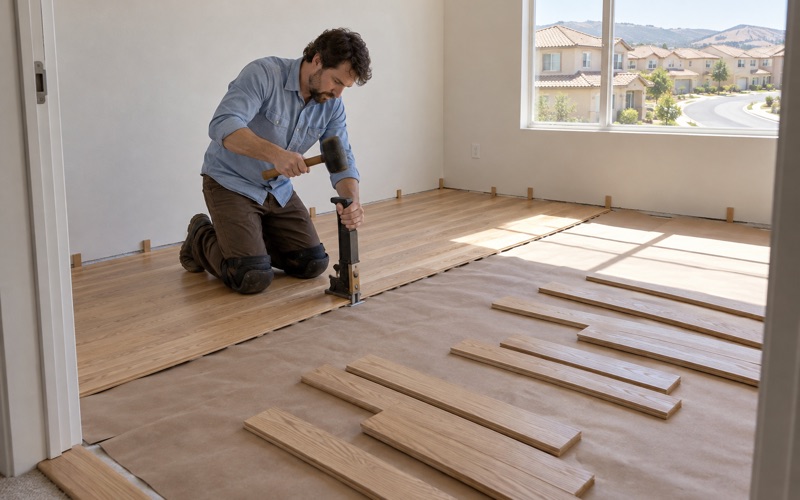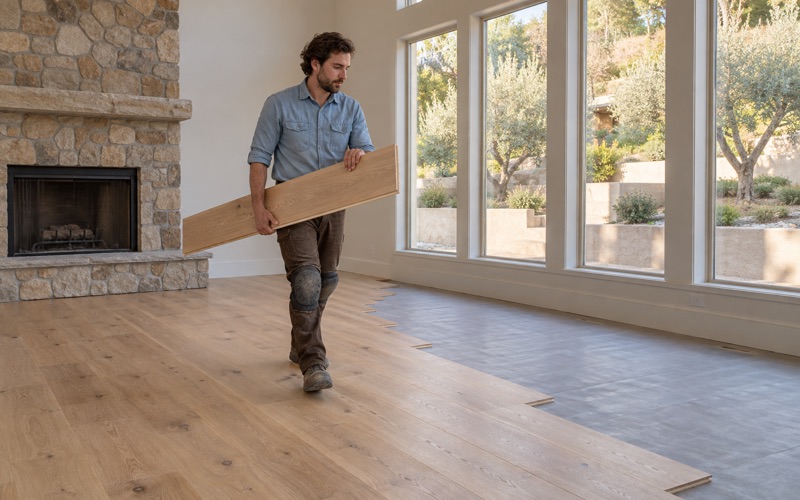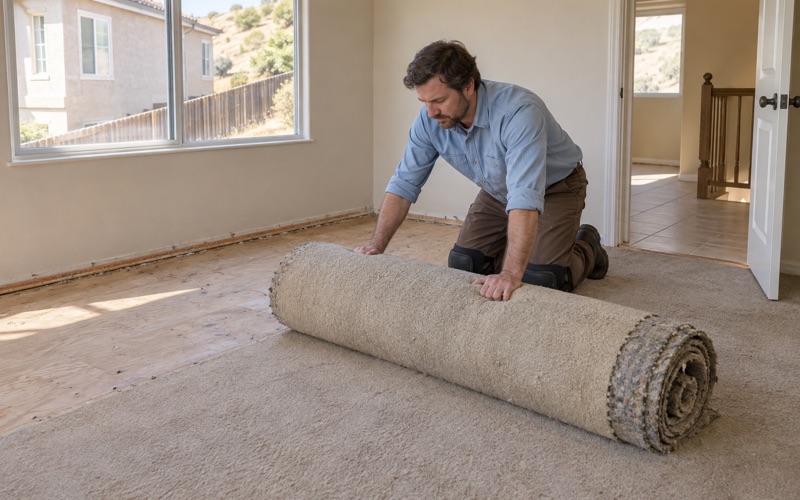
Diamond Bar Wood Flooring handles wood flooring in Hawaiian Gardens with more than 20 years of sanding, repairing and installing hardwood behind us. Most calls here start with a floor that has already lived through several owners or several tenants, and the first job is working out what is actually underfoot. That means checking whether a board is solid hardwood or engineered, how much sanding it can take, and what the subfloor looks like where a board has moved.
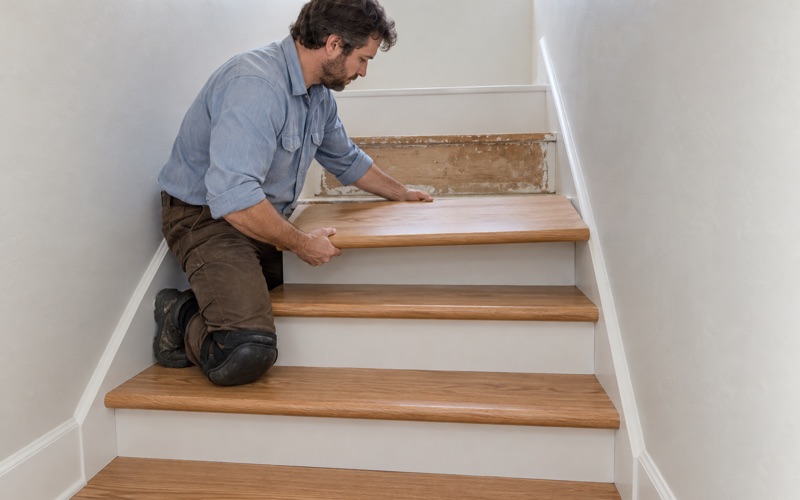
We quote refinishing, screen and recoat, board replacement, weave-in repair and new installation, and we price each one against the house in front of us rather than a flat rate. Stairs get their own line on the estimate, counted by the tread and riser. Engineered planks get their wear layer measured before anyone promises they can take a drum sander.
Older homes also change how the work itself runs. We confirm the year a house was built before sanding begins, set up dust containment with HEPA dust extraction, and sequence rooms so a household can keep living in the home. When a refinish is done, you get a written cure schedule covering foot traffic, furniture and rugs.
Floors in Homes Older Than the City
A housing stock that came first
Hawaiian Gardens incorporated on April 9, 1964, but much of its housing was already standing by then. The ACS 2024 5-year estimates show 52.5 percent of the city’s 4,105 housing units were built before 1970, and 34.0 percent before 1960. In practical terms, a majority of the floors we see here sit in buildings that predate the city government itself.
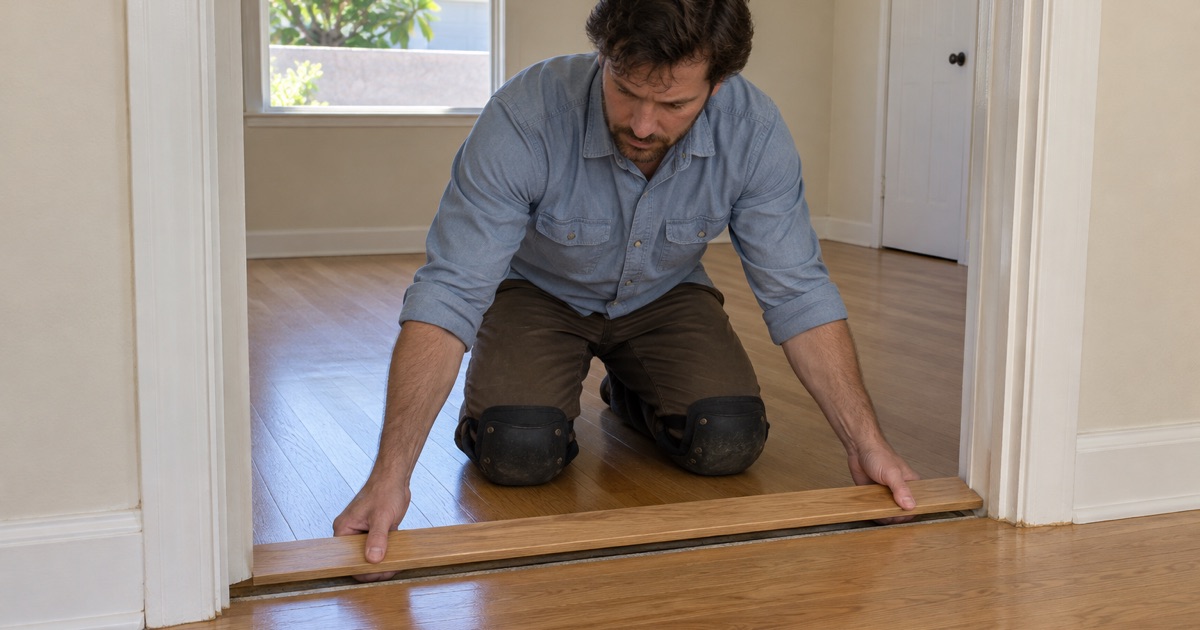
That age matters more than any single material. A house that has been standing for sixty years or more has usually been through several rounds of flooring decisions, and each one leaves something behind. Before we recommend refinishing or replacement, we pull a register cover or check a threshold to see how many layers are stacked on the subfloor.
Lead-safe work before the sander starts
Nearly three quarters of the homes in Hawaiian Gardens, 73.7 percent, were built before 1980. That puts most of the city inside the window where the EPA Lead Renovation, Repair and Painting Rule shapes how sanding and demolition should be handled. We confirm the build year on every job and follow lead-safe work practices on any home built before 1978.
For a floor job, that shows up as containment and cleanup rather than paperwork alone. Doorways are sealed, baseboards and shoe molding come off with care, and sanding dust is collected through HEPA dust extraction instead of swept. The goal is a finished floor without fine dust left behind in an older house.
Reading what decades of repairs left behind
Older floors in this city often carry patches from different eras: a strip of red oak beside a newer section, a room changed to luxury vinyl plank, a hallway with a different board width. Black mastic or cutback adhesive can turn up under old tile or sheet goods, and it has to be identified before any grinding or new glue-down installation. We sort all of that out before a price is written.
Board gapping, cupping and crowning tell us how a floor has handled moisture over time. We take pin moisture meter readings across the room, compare wet and dry areas, and look for a source before blaming the wood. If boards are damaged by a leak, the leak gets found first, and replacement waits until readings settle.
Looking for wood-flooring closer to San Marino? See Wood-Flooring Services in San Marino.
Hawaiian Gardens Houses From the 1940s and 1950s
What a 1940s house asks of a floor
The 1940s alone account for 494 of the city’s housing units, about 12.0 percent, with another 749 from the 1950s. Whatever wood sits in those homes today may be solid stock sanded several times, a later addition, or a newer floor laid over something older. We never assume which until we have looked at the boards themselves.
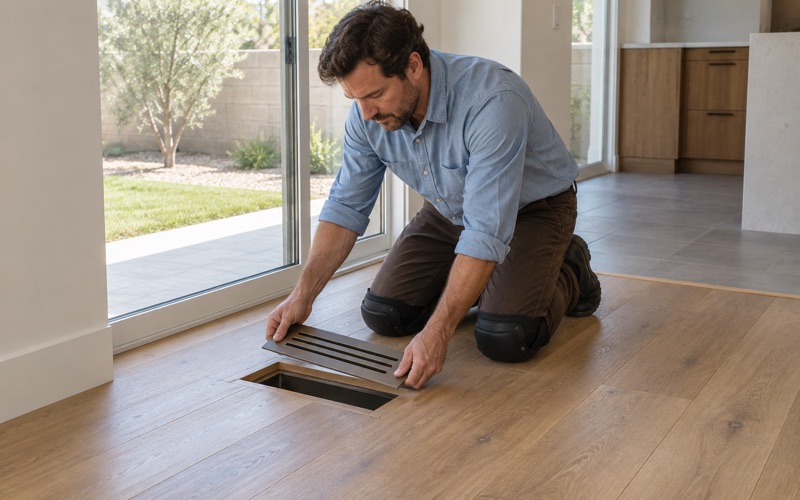
Solid hardwood that has been refinished several times can run short on material above the tongue. We check board edges at a floor vent or a threshold before recommending a full sand, because a floor with little left may do better with a screen and recoat. Pushing a worn floor through a coarse grit sequence can expose nail heads and tongues.
Subfloors, joists and older framing
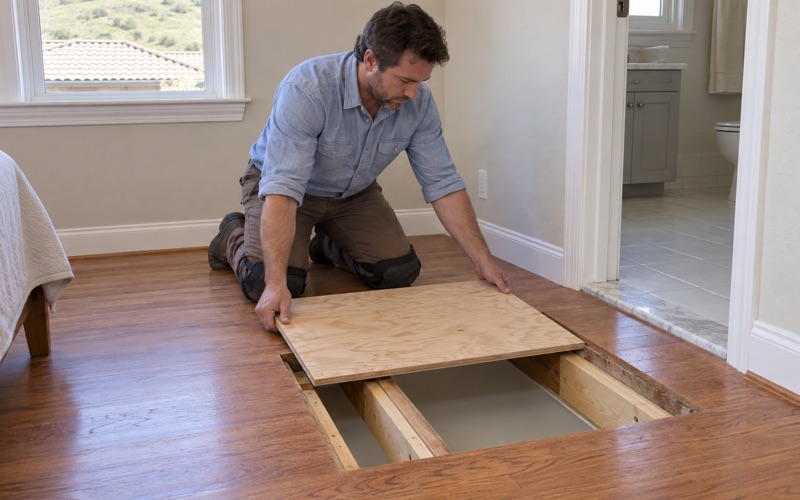
In a house this age, the subfloor under the wood deserves as much attention as the wood itself. We look for soft spots, squeaks that trace to loose flooring cleats or flooring staples, and sections where a past plumbing repair left a patch of plywood subfloor next to older boards. A bounce in the floor can point to a floor joist that needs a sistered joist before new flooring goes down.
Framing repairs belong to the right trade, and we say so when we find something outside flooring work. Where the structure is sound, we level and fasten the subfloor properly so a nail-down installation holds and the new boards stay flat. That groundwork is what keeps a new floor from squeaking a year later.
Choosing wood for a midcentury home
Many owners of 1940s and 1950s houses want a floor that suits the era rather than a trend. Red oak and white oak in a plain-sawn cut fit these homes well, and select grade gives a quieter look while character grade shows more knots and color variation. Rift-sawn and quarter-sawn white oak cost more but move less as humidity changes.
The Janka hardness rating helps compare species for a busy household. Hickory and maple sit higher on that scale than red oak, though maple takes stain unevenly and is often better left natural. We walk through samples with the finish applied, because species, cut and sheen level look different together than they do apart.
Renting and Owning in Shared Buildings
A renter-majority city
Of the 3,948 occupied homes in Hawaiian Gardens, 2,218, or 56.2 percent, are renter-occupied. That makes rental turnover a steady source of floor work here, from a quick screen and recoat between tenants to board replacement after a long lease. Owners and property managers usually want the unit back on the market fast, and the schedule needs to account for that.
We give rental owners a written cure schedule so a move-in date is set around the finish rather than guessed. A waterborne polyurethane typically lets a unit return to use sooner than an oil-modified polyurethane, and it carries less odor for the next occupant. We also photograph the floor’s condition when the work is done.
When a tenant calls about a floor
Tenants sometimes reach us first after a leak or a buckling board. We are glad to inspect and explain what we find, but repairs in a rental are the owner’s decision, and we ask to speak with the owner or manager before quoting work. Moisture readings and photos from that visit can help both sides agree on what happened.
Floor condition at move-out can also connect to California Civil Code 1950.5, the security deposit statute. We do not decide disputes, but we can describe whether damage looks like ordinary wear, such as traffic patterns in the finish, or a specific event like pet stains or water. Clear photos and notes are more useful than memory months later.
Duplexes and attached homes
Hawaiian Gardens has a sizable share of small shared buildings. One-unit attached homes make up 12.0 percent of units and two-unit buildings another 9.3 percent, with 354 more units in three- and four-unit buildings. In these layouts, a floor job in one home can be heard or felt next door.
We plan sanding hours and noisy work with neighbors in mind, and we check whether any association or building rule applies before a floor is ordered for an attached home. Where one unit sits over another, a floating installation over sound-rated underlayment is often discussed, and the right product depends on the building’s own requirements. We confirm those rules in writing rather than assuming.
Planning a Floor Job in a City Under One Square Mile
Small city, close quarters
Hawaiian Gardens covers about 0.945 square miles of land, making it the smallest city in Los Angeles County by area. Its name dates to a fruit stand with palm trees that opened in 1927 at Carson Street and Norwalk Boulevard. Lots sit close together, so parking for a work vehicle and staging for materials are part of our planning.
We bring the drum sander, edger and multi-head orbital sander in through the shortest path and keep cords and hoses out of shared walkways. Boards for a new install are delivered in time to acclimate indoors before installation. In a compact neighborhood, a tidy job site is part of doing the work well.
Finishes, air rules and humidity
Hawaiian Gardens sits within the South Coast Air Quality Management District, and SCAQMD Rule 1113 sets the VOC limit for wood coatings applied or stored at a job site. We choose sanding sealer, polyurethane and hardwax oil products that fit that limit. It narrows the product list, but good compliant finishes are widely available.
The city falls in National Weather Service forecast zone CAZ368, the Los Angeles County Inland Coast area. Seasonal humidity swings can open board gapping in drier months and tighten boards in damper ones. We check moisture in both the wood and the subfloor before installation so the floor is set at a sensible point in that range.
Building questions and termites
Construction and alterations in the city fall under the City of Hawaiian Gardens Community Development Department, Building & Safety Division, which handles building permits, plan review and field inspections. Whether a particular floor project calls for a permit depends on its scope, so we recommend asking that office before structural or subfloor work starts. We would rather you hear it from the division than from us.
Older wood in Southern California can also host drywood termites. Kick-out holes and small piles of termite frass near baseboards are signs we point out, and we refer them to a pest control company before any boards are replaced. Replacing wood before the insects are handled only gives them new material to eat.
- 20+ Years of Wood Floor Work
- Free In-Home Estimates
- Dust-Contained Sanding