
Diamond Bar Wood Flooring repairs, refinishes and installs parquet flooring in Diamond Bar, CA, drawing on more than two decades of hardwood work, and we serve surrounding cities including Walnut, Rowland Heights, South San Jose Hills, Pomona and Brea. Parquet is small-format hardwood laid in a repeating geometric pattern, and it asks for different handling than strip or plank flooring at every stage from glue to sander.
The parquet we see most often was glued directly to concrete or plywood decades ago and has started to loosen, fade or wear through its finish. Some owners want it restored, some want it gone, and many are not sure which is sensible until someone taps across the floor and tells them how much of it is still bonded.
That inspection is where we start. We sound out every area for hollow blocks, check moisture in the slab or subfloor, and look at the adhesive wherever a block is already loose. Those three answers decide whether the floor gets reset and refinished or replaced.
Repairing Loose and Damaged Parquet Blocks
Finding Hollow Blocks Before They Pop
A loose parquet block sounds hollow under a tapping tool long before it lifts, and the pattern of hollow spots tells a story. A cluster near a sliding door points to water, a line along a wall points to expansion with no gap, and scattered spots across the room point to adhesive that has simply aged out. We mark every hollow block on a sketch so the repair plan covers the real extent, not just the pieces already rattling.
That map also keeps the estimate honest. Regluing twenty blocks and regluing two hundred are very different jobs, and it is better to know which one you have before a date is set.
Resetting and Replacing Blocks
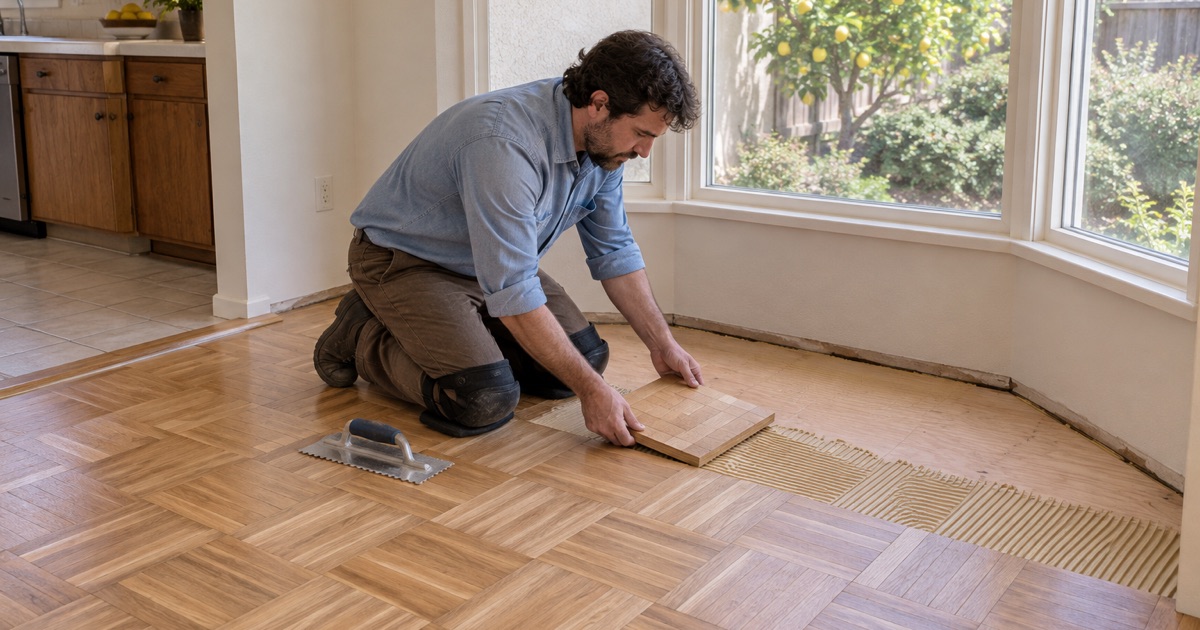
Loose blocks come up, the old adhesive is removed from the substrate and the block backs, and each piece is reset in fresh adhesive to the height of its neighbors. Blocks that are split, cupped or stained through get replaced with new pieces of the same species, thickness and dimensions. We level the repaired areas carefully, because a block sitting even slightly proud will sand thinner than the rest.
When a pattern cannot be matched from stock, we pull blocks from a closet or under an appliance and use new material in the hidden spot instead. That way the visible field stays original wood.
Moisture Behind Failing Adhesive
Parquet laid over concrete depends on the slab staying dry. When readings show moisture coming up through the slab, regluing alone will fail again, so we trace the cause first, whether that is a plumbing leak, a slab leak or a missing vapor retarder. An in-situ relative humidity test following ASTM F2170 gives a reading from inside the slab rather than just its surface.
Over a wood subfloor the check is different. We use a pin moisture meter on the plywood and on the blocks themselves, and look underneath from a crawlspace where the house has one. A subfloor that tests wet gets dried and, where it has softened, repaired before a single block is reglued.
Old Adhesive Under Parquet and Tile
Black Mastic and Cutback Adhesive
Much older parquet and vinyl tile was set in dark, tar-like mastic or cutback adhesive. Some of those products contained asbestos, and nothing about their appearance tells you which ones did. Scraping, grinding or sanding an adhesive before it is tested can release fibers into the house.
We stop and have the adhesive sampled whenever we reach a black layer during tear-out. Removal is planned only after the lab result is in hand.
What Rule 1403 Requires Before Renovation
South Coast AQMD Rule 1403 requires a thorough asbestos survey before renovation, and it spells out that the survey covers all layers of flooring materials down to the joist level. The rule includes narrow exemptions, including one for an owner-occupant personally renovating a single-unit dwelling and one tied to removals under 100 square feet in single-unit homes, but the owner-occupant exemption covers only an owner doing the work personally, never a hired crew. We treat testing as the first step rather than an optional one.
Planning a New Floor Around Old Adhesive
If the adhesive tests clean, it can be removed mechanically and the slab prepared for new flooring. If it tests positive, abatement is handled by a qualified asbestos contractor, not by us, and we schedule our installation after that work is cleared. In some cases a new floor can be installed over encapsulated adhesive, which we discuss once results are known.
Sanding and Refinishing Parquet Floors
Cross-Grain Sanding Without Gouges
Because parquet grain runs in several directions, any sanding pass cuts across the grain on some blocks. We use a multi-head orbital sander for much of the work, keep the drum sander passes light and angled where it is used, and step through the grit sequence gradually. The goal is a flat floor without the chatter and cross-grain scratches that show on parquet under stain.
Edges and corners are finished with an edger and hand scraper, then blended with the orbital machine. Skipping that blending step is what leaves a visible halo around the walls of many refinished parquet rooms.
Stain and Finish Choices on Parquet
Patterned floors show every blotch because neighboring blocks sit at right angles to each other, so stain is tested on a sanded area first. Many owners choose a clear waterborne polyurethane that lets the pattern read through its natural contrast. All finishes we apply stay within the South Coast AQMD Rule 1113 limit for wood coatings.
Sheen matters more on parquet than on plank floors, because a glossy finish exaggerates the slight height differences between blocks when light crosses the room. A satin or matte sheen level keeps the pattern crisp while hiding the small variations every hand-laid parquet floor has.
When Parquet Is Too Thin to Sand Again
Thin parquet tiles that have already been sanded more than once may not survive another full sanding. We check a loose block or a threshold edge to see how much wood remains. If the answer is too little, a screen and recoat or replacement becomes the honest recommendation.
Installing New Parquet Patterns
Basketweave, Block and Versailles Layouts
Classic block and basketweave parquet suits mid-century and traditional rooms, while panel patterns like Versailles bring a formal look to an entry or dining room. Each pattern starts from a layout line at the center of the room so the design sits square to the main wall and the cut pieces at the perimeter are balanced. Getting that line right is the difference between a pattern that looks deliberate and one that drifts.
Species changes the character of each pattern as much as the layout does. White oak parquet reads calm and even, walnut or mixed species can create a strong contrast between blocks, and a character grade brings knots and color variation that suit a rustic room. We bring sample blocks so you can see the pattern at full scale on your floor.
Parquet Beside Herringbone and Plank Floors
Parquet pairs well with herringbone and straight plank flooring when a border or feature strip separates them. We plan the transition so that board widths and colors line up and a T-molding or reducer is used only where a height change demands it.
Unfinished or Prefinished Parquet
Unfinished parquet is sanded flat after installation and finished on site, giving a smooth, continuous surface. Prefinished parquet arrives with a factory coating and installs faster, though its edges stay slightly beveled. We recommend one or the other based on the room and how the floor will be used.
For a kitchen or entry that sees grit and spills, site-finished parquet is usually the stronger choice because the finish seals across the joints instead of leaving tiny grooves where dirt and water collect. Prefinished blocks suit a bedroom or office where fast installation matters more.
- 20+ Years of Wood Floor Work
- Free In-Home Estimates
- Dust-Contained Sanding