
Diamond Bar Wood Flooring handles subfloor repair in Diamond Bar, CA, backed by more than 20 years of work under and on top of hardwood floors, and we serve surrounding cities including Walnut, Rowland Heights, South San Jose Hills, Pomona and Brea. A hardwood floor can only be as flat, quiet and stable as the layer it is fastened to, and that layer is where many floor problems actually start.
We get called when a floor feels soft by a bathroom door, when a kitchen floor dips in front of the dishwasher, when squeaks spread through a hallway, or when old carpet comes up and the plywood underneath is stained, lifted or crumbling. In Diamond Bar, where most houses date to the 1970s and 1980s, the subfloor under a tired floor has usually been there for several decades.
Our approach is simple to describe and careful to carry out. We find the cause, cut back to sound material, fix the framing where needed and prepare a flat, firmly fastened surface before any finished flooring is replaced.
Signs Your Subfloor Needs Repair
Soft Spots Near Kitchens and Bathrooms
The most common subfloor damage we find is around a toilet flange, a tub or shower, a dishwasher, a refrigerator water line or a water heater. Small, slow leaks soak into plywood or OSB for months before the hardwood above shows anything more than a dark stain or a slight give underfoot. By then the panel may be delaminated or soft enough to push a screwdriver into.
We probe the area, take readings with a pin moisture meter and cut an inspection opening where needed. A leak that is still active is fixed by a plumber before we replace a single panel.
Dips, Humps and Uneven Floors
A floor that dips between two points often has a sagging joist or a subfloor panel that has lost its support. A hump can come from a swollen panel edge or a joist that has crowned. Both make new hardwood harder to install flat and can leave boards rocking or gaps opening over the high and low spots.
We check flatness with a long straightedge across the room and mark every variation. That map shows whether the problem is local and fixable at the panel or runs down into the framing.
Squeaks, Bounce and Loose Fasteners
Squeaks that spread through a room and a floor that bounces when someone walks past are usually signs of subfloor movement rather than the finished boards alone. Panels may have separated from the floor joists, old nails may have backed out, or the joists may be undersized for the span. We tighten the system from below where a crawlspace allows, or from above during a flooring replacement.
Repairing Plywood, OSB and Framing
Cutting Back to Sound Subfloor
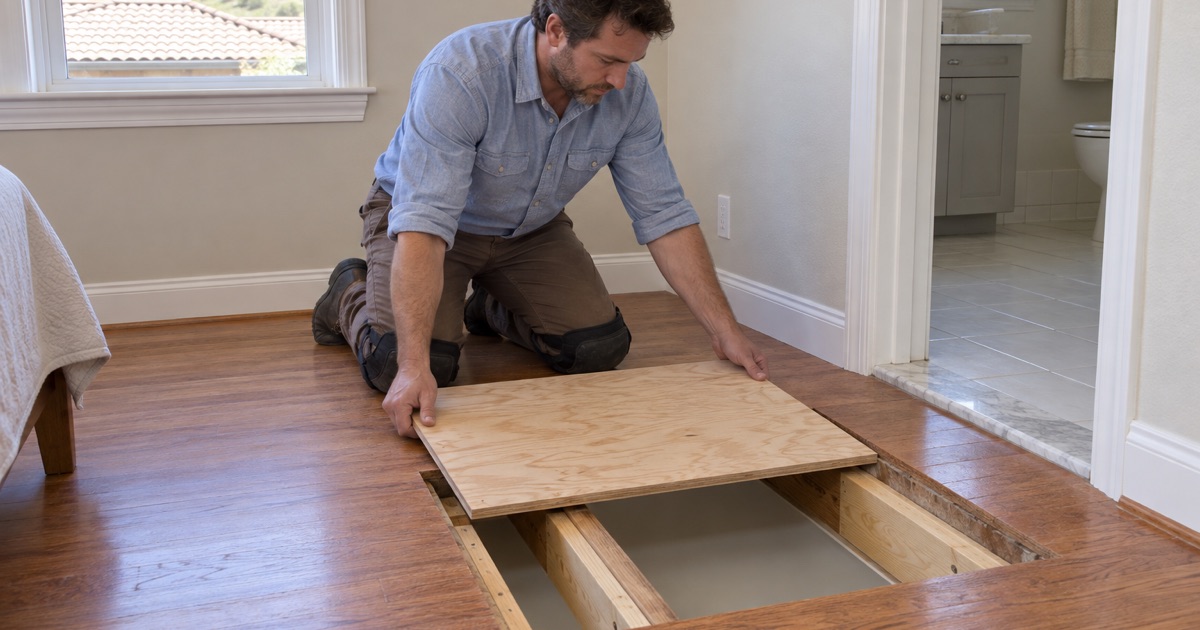
Damaged subfloor is cut back until the edges are solid, with the cut lines placed over joists or with added blocking so the new panel edges are fully supported. The replacement panel matches the thickness of the original, whether plywood subfloor or OSB subfloor, so the finished floor stays level across the repair. We glue and screw new panels to the framing to keep them from working loose. Where old panels have simply loosened, rather than rotted, we refasten them with screws into the joists instead of replacing sound material.
Sistering Damaged Joists
A joist that has been cracked, over-notched for plumbing, or weakened by past water or insects can often be reinforced with a sistered joist fastened along its length. That restores stiffness without removing the original member. Where damage is extensive, or where framing problems appear across a larger area, we recommend a structural evaluation before any repair is designed.
We will not treat framing damage as a flooring problem. The right fix for a structural issue comes from the right professional, and we coordinate our flooring work around it.
Termite Damage Below the Floor
When we open a subfloor and find the galleries and pellets left by drywood termites, work stops at that point. We document the damage and refer you to a licensed pest control company, since a 1998 California Structural Pest Control Board fact sheet says fumigation or heating the entire house are the only ways to be sure of eradication across the structure. Framing and subfloor repair follow treatment, not the other way around.
Preparing the Subfloor for New Hardwood
Flattening Seams and Filling Low Spots
New hardwood needs a flat, sound base to lie on. We plane or sand down high panel seams, fill low areas with a compatible leveling product, and replace any section too uneven to correct. National Wood Flooring Association installation guidelines treat subfloor flatness and fastening as part of the installation itself, not as an optional extra. Skipping preparation is the most common reason a new floor squeaks, rocks or opens gaps within the first year.
Moisture Testing Before Installation
Wood subfloors are tested with a pin moisture meter and compared with the moisture content of the new flooring, since too large a difference leads to gaps or cupping after installation. Concrete slabs get an in-situ relative humidity test following ASTM F2170 before glue-down or floating floors go over them. We also check for a vapor retarder where the installation calls for one.
Choosing Nail-Down, Glue-Down or Floating
A sound plywood or OSB subfloor supports nail-down installation with flooring cleats or flooring staples. Concrete slabs usually take glue-down or floating installation over the right underlayment. We match the method to what is underneath rather than forcing a product onto a surface it was not designed for.
Subfloors in Diamond Bar Homes and Condos
Hillside Houses and Movement Warning Signs
The City of Diamond Bar notes that many homes sit at the top or along the base of privately owned hillsides and that water causes most slope stability problems. Its slope maintenance guidelines tell owners to watch for widening cracks in flatwork or walls and doors or windows that stick. If those signs show up with a floor that has started to slope, a geotechnical or structural professional should look before we repair the floor above.
Earthquake Retrofits and Floor Framing
The 2025 Earthquake Brace + Bolt ZIP code list for Southern California includes Diamond Bar’s 91765. Owners planning a seismic retrofit through that program or on their own should schedule it before subfloor and flooring work, so that any access openings and framing changes are made once. We are glad to work around a retrofit contractor’s schedule.
Condo and Townhome Subfloors
In a condo or townhome, whether the subfloor, slab or joists are part of your unit or the association’s common area depends on your governing documents. California Civil Code section 4760 lets a member improve their separate interest only where the change does not impair structural integrity or lessen the support of other parts of the development. We read those documents before quoting and involve the association where the work reaches beyond your unit.
- 20+ Years of Wood Floor Work
- Free In-Home Estimates
- Dust-Contained Sanding