
Diamond Bar Wood Flooring installs and refinishes wide plank flooring in Diamond Bar, CA, with more than 20 years of hardwood experience behind every board we set, and we serve surrounding cities including Walnut, Rowland Heights, South San Jose Hills, Pomona and Brea. Wide planks show more of each board’s grain and make a room feel calmer and larger, but they also magnify every mistake in moisture control and preparation.
Most of Diamond Bar’s houses date from the 1970s and 1980s. Owners replacing an older narrow strip floor or carpet in those houses with wide plank white oak are after a more open, modern look, and the choice of construction and installation method is what determines whether that floor stays flat once the seasons turn.
We walk through the tradeoffs before you choose: engineered or solid, species and cut, glue, nail or float, and the finish that suits wide boards. Each decision is made with your subfloor readings in hand.
Why Wide Boards Need More Care
Wood Movement Across the Width
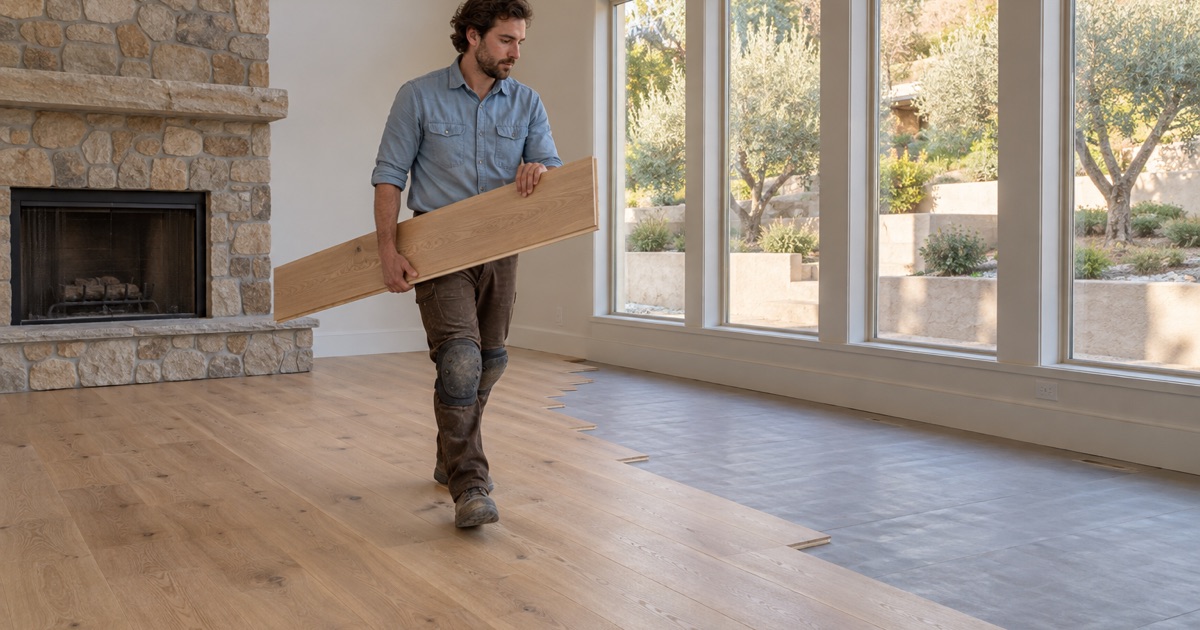
Wood swells and shrinks mostly across its width, not its length. A wide board therefore moves more at each seam than a narrow strip, so seasonal changes show up as more visible gaps in dry months and more pronounced cupping when moisture rises. That does not make wide plank a poor choice, but it does make preparation and moisture control essential rather than optional.
Indoor conditions matter after installation too. Homes that swing between air-conditioned summers and heated winters see more movement, and we talk through keeping humidity steady to protect the investment.
Board Gapping in Dry Months
Some seasonal board gapping is normal in solid hardwood and tends to close again when humidity returns. On wide plank, those gaps are easier to see and can collect dirt. Installing at the right moisture content, and choosing an engineered product where conditions are variable, keeps gapping to a minimum.
Cupping and Crowning
When the underside of a wide board takes on moisture from a slab, crawlspace or leak, the edges rise and the board cups. If a cupped floor is sanded flat before it dries, the edges drop as the wood dries out and the board crowns instead. We test moisture thoroughly before installation and take readings again before sanding any floor that shows cupping.
Engineered or Solid Wide Plank
Engineered Wide Plank
Engineered hardwood layers a real wood wear layer over a cross-laminated core, which restrains movement across the width. That stability makes engineered construction a frequent choice for wide planks, especially over concrete slabs. We check the wear layer thickness when choosing a product, since a thicker veneer allows future sanding, and we confirm CARB Phase 2 or TSCA Title VI compliance for the core.
Solid Wide Plank
Solid wide plank offers the most material to sand over the floor’s lifetime and a traditional feel underfoot. It requires a sound wood subfloor, careful acclimation to the home’s conditions and a fastening method that holds wide boards flat. Over slabs, we generally recommend engineered construction instead.
Rift-Sawn and Quarter-Sawn Boards
The way a log is cut affects stability as well as appearance. Plain-sawn boards show broad cathedral grain and move more across their width. Rift-sawn and quarter-sawn boards have straighter, tighter grain and move less, which makes them a good match for wide widths. They cost more, but they reduce the movement wide plank floors are known for.
Installing Wide Plank Flooring
Subfloor Flatness and Moisture Testing
Long, wide boards bridge dips in a subfloor rather than following them, which leads to hollow spots and bounce. We flatten plywood and OSB subfloors, screw down loose panels and fill low areas. Wood subfloors are tested with a pin moisture meter, and slabs receive an in-situ relative humidity test following ASTM F2170 before any adhesive goes down.
Glue-Assisted Nail-Down
Over wood subfloors, wide solid and engineered planks are often nailed with flooring cleats and also bonded with adhesive along the board. The adhesive keeps wide boards from cupping away from the subfloor between fasteners. We follow the fastener spacing and adhesive method recommended for the specific product.
Layout matters as much as fastening. Wide boards usually come in mixed lengths, and we rack them out across the room before installation so end joints are staggered and short pieces are spread evenly rather than clustered at one wall. Running the planks along the longest sight line, often from the front door toward the back of the house, makes the most of the wide look.
Glue-Down and Floating Over Slabs
On concrete, engineered wide plank is glued down with a moisture-rated adhesive or floated over a suitable underlayment. In condos and townhomes, a sound-rated underlayment may be required, with the rating set by the association’s rules. We confirm those requirements before ordering materials.
Species, Grade and Finish
White Oak and Other Species
White oak is a favorite for wide plank because its tight grain and neutral tone suit natural, light and gray-brown finishes. Hickory brings dramatic color variation, while maple offers a smooth, contemporary look. We bring full-length sample boards, since a short sample does not show how a wide board reads across a room.
Character Grade and Select Grade
Character grade boards include knots, mineral streaks and color variation, which many owners choose for a relaxed, rustic look on wide plank. Select grade boards are cleaner and more uniform. The grade also affects price, so we show both options side by side. Character grade also hides everyday dents and scratches better, which suits a household with children or dogs.
Finishes and Sheen Level
Wide plank floors often look best in a low sheen level, which hides scratches and emphasizes grain rather than reflection. We use matte waterborne polyurethane or hardwax oil systems that fit the South Coast AQMD Rule 1113 limit, and every site-finished floor comes with a written cure schedule for walking, furniture and rugs.
- 20+ Years of Wood Floor Work
- Free In-Home Estimates
- Dust-Contained Sanding